First things first: you're not the only one. Cover-ups are some of the most common requests in any tattoo studio, and some of the most satisfying to do. Whatever is under your sleeve right now, we've probably seen something similar. Nobody here is going to raise an eyebrow, except maybe in admiration of how fun the redesign is going to be.
How cover-ups actually work
A cover-up doesn't erase old ink. It camouflages it. A new design is placed strategically so that its darker areas, textures and shapes absorb the old lines. Your eye reads the new tattoo and skips right past the old one.
That has a few practical consequences:
- The new tattoo is usually larger than the old one, often noticeably so.
- It usually needs darker areas where the old ink sits. You can't hide black under pale grey.
- Certain designs work better: organic shapes like florals, feathers, animals, waves and smoke are excellent at hiding things. Thin, airy linework isn't.
- Not every old tattoo is a candidate for a straight cover-up. Very dark or very large pieces may need a different plan.
Cover-up, rework or fade first?
Here's how we think about the options during your free assessment.
| Your old tattoo | Likely best option | What it involves |
|---|---|---|
| Light, faded or thin-lined | Direct cover-up | New design designed around the old one, usually in one plan |
| Decent linework, dated design | Rework | Keep and refresh parts of it, adding shading, detail or new elements |
| Blurry or blown-out lines | Cover-up with bold, dark areas | Strong contrast and texture to absorb the blur |
| Very dark, dense or large | Laser fading first, then cover-up | Lightening with a laser specialist before we tattoo over it |
| Small name or date | Cover-up or clever integration | Often hidden inside a floral, animal or ornamental design |
We'll be honest if laser fading would give you a much better result. We don't do laser in-house, but we'll talk you through why it may help and when to come back.
What to expect at your assessment
- Show us the tattoo. In person is best, because photos hide how dark and how deep the ink is.
- Tell us what you'd love instead. Style, mood and any must-haves or absolute no's.
- We map the old tattoo and work out where dark areas must fall in the new design.
- We talk honestly about size, style, placement and whether one or more sessions are likely.
- Mukhilan designs your cover-up, usually drawing directly around the old ink so you can see how it hides.
- Stencil, mirror, adjust. Only when you're happy do we start.
All work uses autoclave-sterilised tools and single-use needles, as always.
Styles that make great cover-ups
- [Black and grey](/services/black-and-grey-tattoo): smooth shading and deep shadows are excellent at absorbing old lines.
- Blackwork and ornamental: bold patterns and solid black areas can hide almost anything.
- [Traditional](/services/traditional-tattoo): thick outlines and solid fills are cover-up champions.
- Nature and texture: florals, foliage, feathers, fur, waves and smoke are full of natural camouflage.
- [Realism](/services/realistic-tattoo): possible, but it needs careful planning and usually a generous size.
Designs that struggle as cover-ups include very light fine line work, pale watercolour effects and lots of open skin. Keep them for fresh canvas.
A cover-up checklist
- I'm open to the new tattoo being larger than the old one
- I'm happy for the design to include darker areas
- I've brought a few style references, not one rigid image
- I'm willing to consider laser fading if it means a much better result
- I've planned healing time around beach days and travel
- I've told the artist about any scarring or past healing issues
Why old tattoos fade, blur or "blow out"
Understanding what went wrong with the first tattoo helps us plan a better second one.
- Blowouts happen when ink spreads beneath the skin during tattooing, leaving blurry halos around lines. They're usually caused by too much depth or very thin skin. Cover-ups with bold, textured elements hide them well.
- Fading comes mostly from sun exposure, plus time and friction. Faded tattoos are often the easiest to cover.
- Blurring happens when lines were placed too close together, or the design was too small for its detail. As ink naturally settles, everything merges.
- Uneven healing, from picking, swimming too early or infection, can leave patchy areas that need extra attention in the new design.
Whatever happened, it's not your fault, and it's fixable more often than not. The useful part is what it teaches us. If the first tattoo blurred because it was too small, the cover-up gets more room. If it faded in the sun, the new piece comes with a sunscreen lecture (a short, friendly one). And if it blew out on thin skin, we adjust our approach for that area.
Pain, sessions and planning
Tattooing over existing ink feels much like tattooing fresh skin. If the old tattoo has scar tissue, those areas can feel more sensitive, and they need a lighter, more careful touch. Smaller cover-ups are often done in a single session. Larger ones are split across two or more, with healing time between. That gives us a chance to check how well the old tattoo is hidden and add more depth where needed.
Preparing for your cover-up session
- Keep the area out of the sun in the weeks before. Tanned or burnt skin is harder to work on
- Moisturise the area daily, because healthy, hydrated skin takes ink better
- Eat a proper meal and stay hydrated on the day
- Skip alcohol for at least 24 hours beforehand
- Wear clothing that gives easy access to the area
- Bring your reference ideas and an open mind
What shapes the price
Cover-ups are quoted after we've seen the old tattoo in person. The main factors are the size and darkness of the original, the size of the new design, how much shading and solid black it needs, and how many sessions it will take. Rework jobs, where we refresh rather than fully hide, are often simpler. You'll get an honest plan and quote before anything starts.
Healing a cover-up in Pondicherry
Cover-ups are often larger and denser than first tattoos, and the skin may have been tattooed before. Give it extra care.
- Wash gently two to three times a day with mild, fragrance-free soap. Pat dry.
- Moisturise thinly. In humid weather, thick layers trap sweat.
- Wear loose clothing, especially if you're riding a scooter around town in the afternoon heat.
- Skip swimming in the sea, pools and tubs until it's fully healed. That's often a little longer for big pieces.
- Keep it out of the sun while healing. After that, sunscreen for life, so the old tattoo never peeks back through as the new one fades.
- Expect some ghosting while healing. Old lines can look visible during the first weeks, then settle as the new ink heals.
If you notice spreading redness, growing pain or fever, see a doctor promptly and let us know.
If you're travelling after your session
Cover-ups are often bigger pieces, so healing on the road needs a little more thought. Keep a fragrance-free cleanser and clean paper towels in your day bag. Wear soft, loose layers on flights and long bus rides. Avoid backpack straps or seatbelts pressing on the fresh tattoo where you can. If you're staying somewhere with a pool, admire it from a sunbed in the shade for now. Send us photos during healing if anything looks unusual. We'd much rather answer a question early than fix a problem later.
Finding us
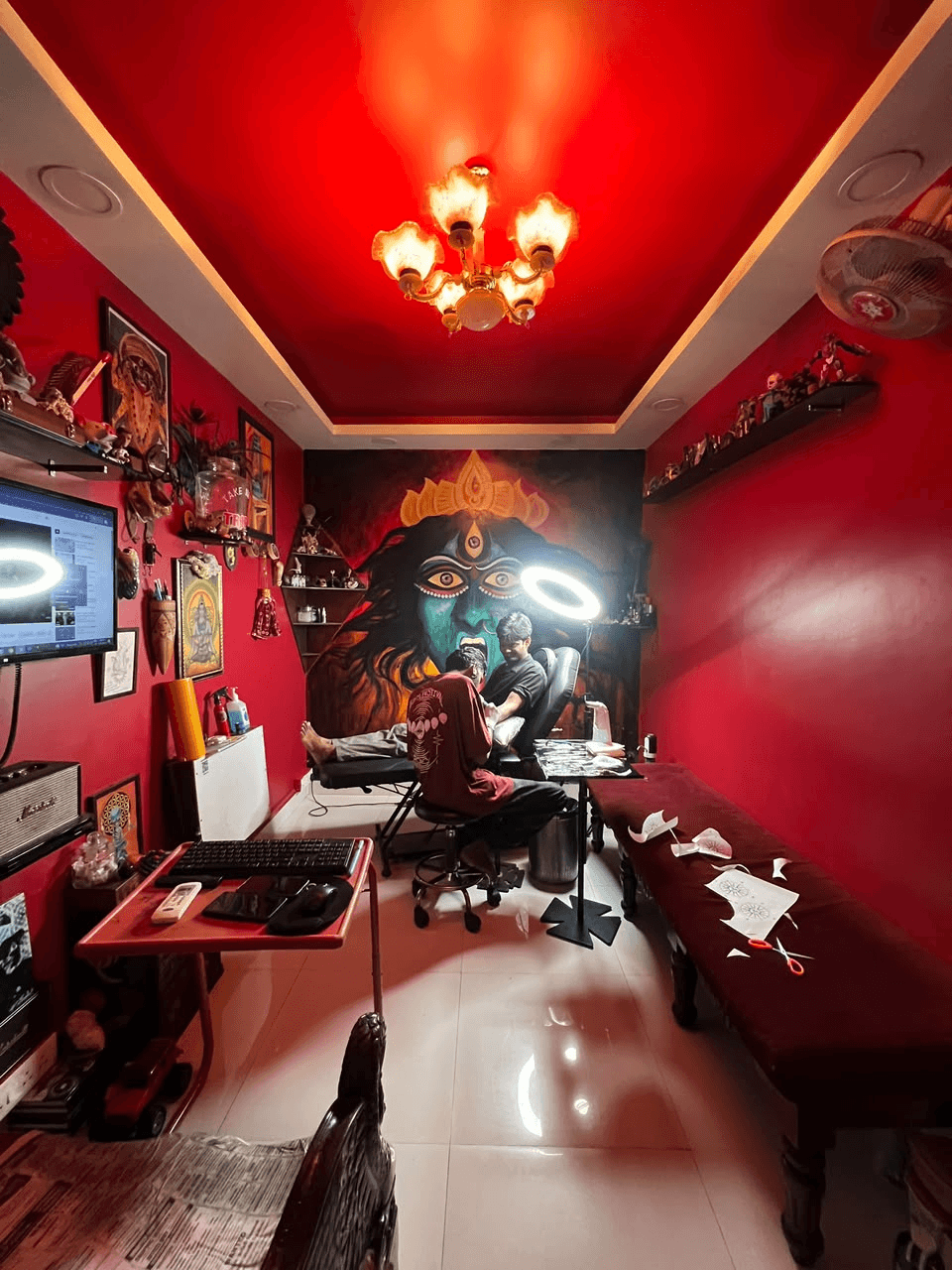
The studio is at No. 34, Law De Lauriston Street, near Central Bank of India, in White Town. Plenty of our cover-up clients are locals. If you're searching for the best tattoo shop near Lawspet, Muthialpet or Reddiarpalayam, it's a short ride into the French Quarter. Visitors staying near the Promenade, in Auroville or along the ECR find us easily too.
Your next chapter starts with a chat
A cover-up is the ultimate test of any studio claiming to be the best tattoo shop in Pondicherry, and we're always happy to be tested. Bring the tattoo you're done with and an open mind about what comes next. Walk in, send a photo on WhatsApp, or contact the studio here. Want to know who'll be redesigning it? Meet Mukhilan.